


The American Table
January 4, 2026
On Saturday morning, as Americans woke to news of airstrikes on Venezuela and a sitting president in U.S. custody, young Europeans were already three hours into their weekend ritual: dancing stone sober in Parisian bakeries, surrounded by baguettes and pain au chocolat, DJ spinning against a backdrop of rising dough.
The juxtaposition isn’t subtle. It wasn’t meant to be.
The bakery rave phenomenon—which began in Paris in 2019 and has since spread to Brisbane, Mumbai, and Toronto—tells us something about what a generation is choosing when they can choose anything. They’re choosing bread over bottles. Dawn over midnight. Carbs over cocktails. And increasingly, they’re choosing Europe over here.
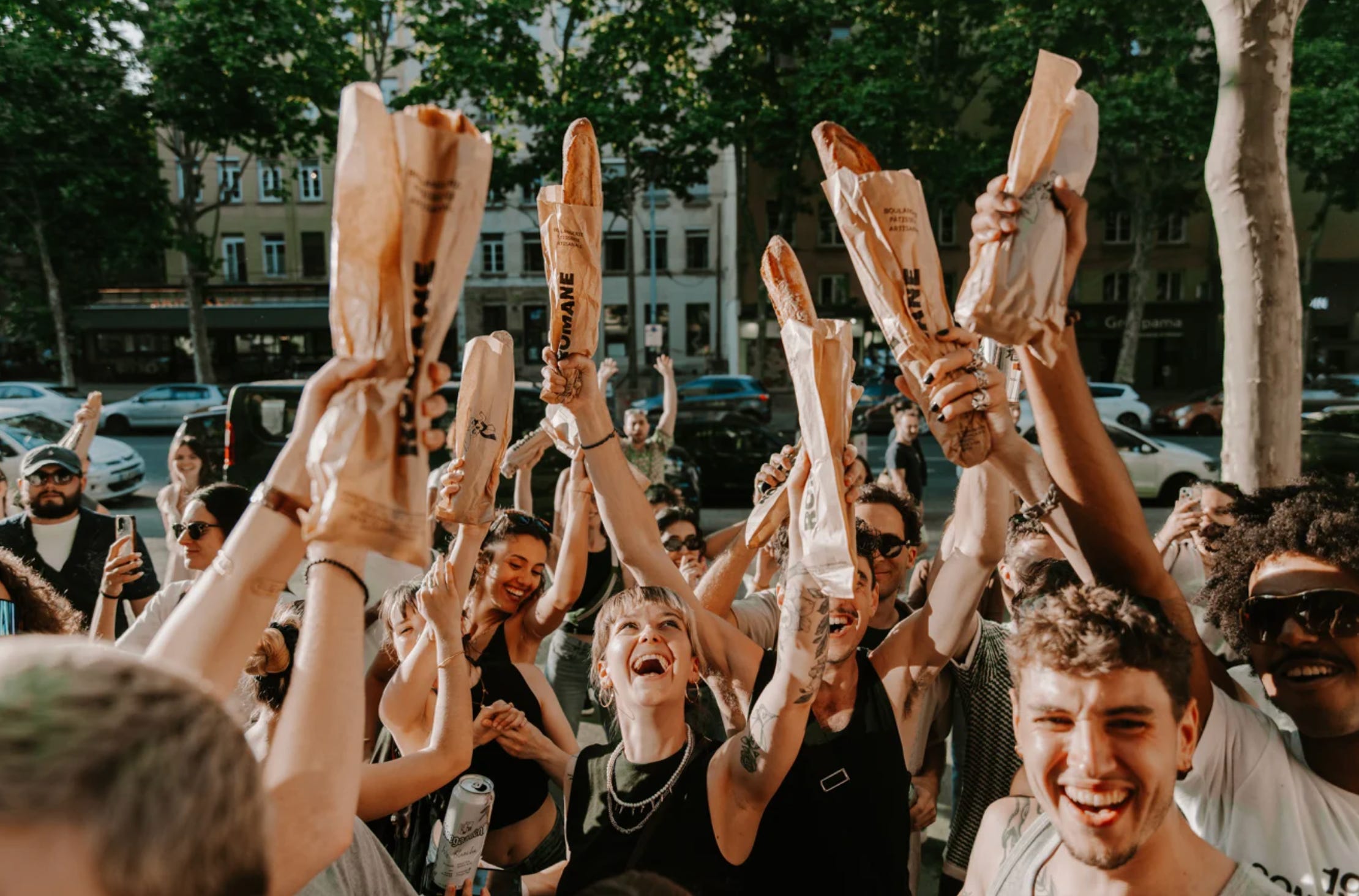
Alexis Duvivier didn’t set out to create a sobriety movement when he launched the first bakery rave at The French Bastards in Paris’s 11th arrondissement. The French DJ and producer, who performs as Aazar, was solving a simpler problem: homesickness. After years working clubs in Miami and Los Angeles, what he missed most wasn’t the nightlife—he had plenty of that. He missed the Boulangerie.
“It was such a big part of my culture in my everyday life here in France,” Duvivier said in a recent interview. “It was the first thing I wanted to do when I went back. I was always on the lookout for the best baguette or the best pain au chocolat.”
So in 2019, to celebrate releasing his single “Diva,” he did what made sense to him: he threw a free early evening party at a bakery, spinning tracks while trays of pastries circulated through the crowd. The visuals were odd enough to go viral—DJs Bob Sinclair and Peggy Gou later played sets there, cementing The French Bastards as one of Paris’s most unlikely hot spots.
But Duvivier insists the concept wasn’t gimmicky. “I didn’t choose a bakery because I was looking for an unusual location, but because for me it represents France and represents what I love.”
What he loved was the thing itself, not the Instagram version of it. The actual butter. The actual crust. The actual gathering place where neighbors see each other daily, not the performative authenticity that passes for culture in algorithm-optimized America.
That distinction matters more this weekend than it did last weekend.
The bakery rave movement has found its biggest following among Gen Z and younger Millennials who are drinking less and prioritizing what previous generations might have called boring: sleep, health, wellness, showing up clearheaded. From a certain angle, it looks like retreat. From another, it looks like the sanest response available to people who’ve watched the world they inherited catch fire in real time, and decided the least they can do is not pour alcohol on it.
The kids dancing in Paris bakeries at 8 a.m. on a Saturday aren’t protesting. They’re not marching. They’re not posting manifestos or arguing on Twitter about what just happened in Caracas. They’re doing something both smaller and larger: they’re building the world they want to live in, one baguette and one sober dance floor at a time.
They’re also doing it over there, not here.
Europe has become aspirational to Americans in a way it hasn’t been since before 9/11. Not the Europe of backpacking tourists or study abroad semesters, but the Europe of people who take August off and eat lunch for two hours and don’t think healthcare is a luxury good. The Europe where a bakery is a daily democratic ritual, not a $8 artisanal experience you Instagram. The Europe where young people can imagine a future that doesn’t require them to explain away their government’s foreign policy at dinner parties for the rest of their lives.
You can hear it in how Americans talk about Europe now—not with the old defensive superiority (”they don’t have free speech/air conditioning/ambition”), but with something closer to longing. We sound like Duvivier in Los Angeles, homesick for a boulangerie.
The bakery rave works because it’s performing authenticity by actually being authentic. Duvivier didn’t focus-group the concept or hire a brand consultant. He missed bread. He liked music. He put them together. The fact that it became a movement says less about his marketing savvy than about how starved people are for experiences that aren’t optimized, monetized, or weaponized.
In Washington, where I write this, we’ve spent two decades watching policymakers perform concern about foreign interventions while authorizing them. We’ve watched both parties promise to end forever wars while finding new forevers to war in. We’ve normalized a level of military involvement around the globe that would have been unthinkable to the generation that actually fought World War II, and we’ve done it while telling ourselves we’re the reluctant hegemon, the force for good, the grown-ups in the room.
The kids aren’t buying it anymore. They’re not even shopping in the same store.
When American twenty-somethings look at Europe now, they’re not seeing a museum of old cathedrals and socialist policies. They’re seeing a place where it’s possible to be young and hopeful without being naive. Where you can dance at 8 a.m. with a croissant in your hand and not feel like you’re fiddling while Rome burns, because you’re not the one who lit the match.
The French Bastards, the bakery that started all this, distinguishes itself with what it calls an “irreverent and innovative menu.” But the real irreverence isn’t in the food. It’s in the premise that young people might gather for joy rather than to numb themselves to the news. That morning might be better than midnight. That the smell of baking bread might be more nourishing than another round of drinks you don’t want to pay for and won’t remember.
That watching the sun come up might be better than staying up to see what fresh hell tomorrow brings.
As Duvivier’s concept spread—he now hosts Bakery Sessions across Europe—it stayed true to its origins. No sponsorships. No bottle service. No VIP section where you pay more to stand closer to the baguettes. Just music, pastries, and people who chose to be there clearheaded.
Meanwhile, back in America, we’re conducting operations to secure another country’s oil reserves while a military official quotes a president saying we’ll “run it for them for a period of time.” We’re doing this on a Saturday. We’re doing this in January. We’re doing this while half the country argues it’s justified and the other half argues about whether they’re allowed to say it’s not.
The kids dancing in Paris aren’t having that argument. They opted out. Not in the cynical Gen X way of the 1990s, where opting out meant you were too cool to care. In a way that suggests they care deeply, but they’ve decided caring doesn’t require participating in a system that will grind up their caring and use it as fuel.
They’re building something else instead. It’s smaller. It’s quieter. It happens at bakeries.
And for those of us who stayed, who are still here in America trying to write sense into senselessness and reason into rage, there’s something almost unbearably poignant about watching a generation choose bread and music and sobriety while we chose empire and oil and the certainty that this time, finally, we’ll get it right.
Duvivier says his bakery raves were never meant to become a social media trend. He was just trying to recreate the thing he loved about home. But maybe that’s exactly why it worked. Maybe the only authentic thing left is to stop trying to solve the world’s problems and start trying to solve your own homesickness.
Maybe the revolution isn’t a march or a manifesto. Maybe it’s just deciding that at 8 a.m. on a Saturday, you’d rather be dancing in a bakery than doom-scrolling the news from Caracas.
Maybe the kids who are dancing—sober, joyful, surrounded by bread—have figured out something we spent fifty years of foreign policy missing: that the thing people actually want isn’t democracy at gunpoint or oil secured by airstrikes.
It’s a good baguette and a place to gather.
And it turns out, you can’t export that at the end of a cruise missile.
James Bell writes The American Table from Washington, D.C., where he watches what we eat and what it means.