

Letter from London: The Space Between Our Refrigerators and Our Front Doors
On World Hunger Day, a London food bank now rescues 44 million meals a year. Its shoppers still complain that the strawberries have run out.

For World Hunger Day - Julia Watson
Two years before the first Covid outbreak in 2019, I began volunteering at The Felix Project. Based in London, it collects high-quality surplus food from suppliers and farms, and also from supermarkets where, as it approaches its Best Before date, it is rejected by privileged shoppers. The still-nutritious food is then redistributed to charities, community organizations, primary schools, and vulnerable individuals.
Back then, for fund-raising purposes, we would quote the statistic that we were moving enough food to create 6 million meals a year, from ingredients that would otherwise go to landfills where it rots and releases methane, a highly potent greenhouse gas.
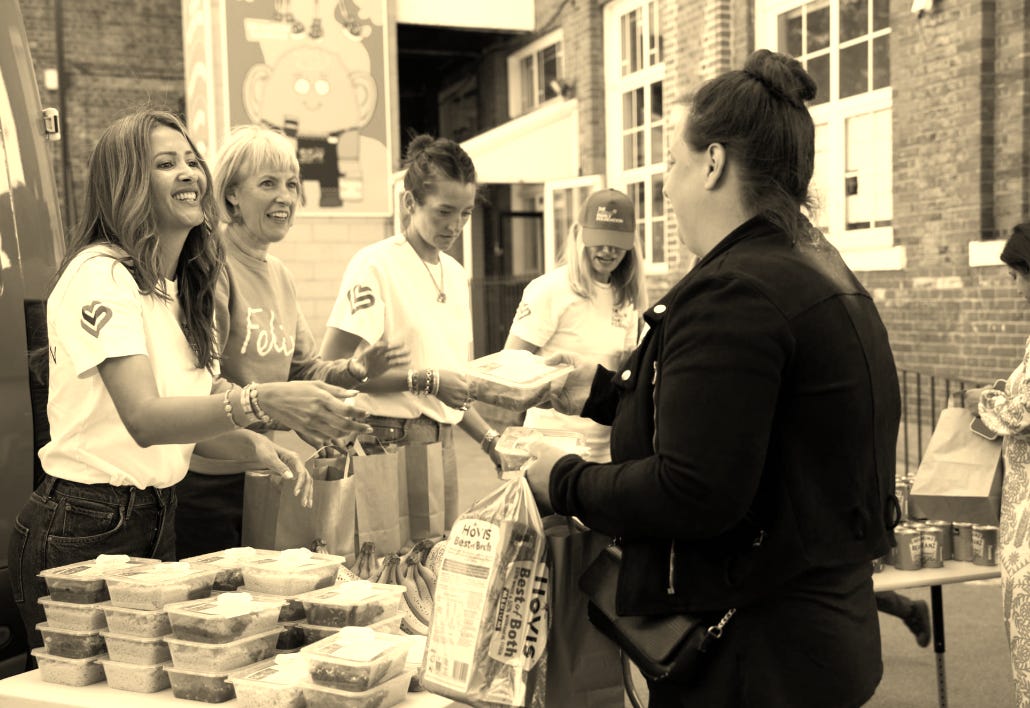
Just 9 years later, The Felix Project creates and redistributes the equivalent of 44 million meals a year, to more than 1200 organizations. Yet it only serves Greater London, an area with a population of just over 9 million. You do the math.
We should be ashamed of ourselves. Successive British governments have abandoned social services and those people, many of whom hold down more than one job in order to feed their families, to the care of the charity sector.
And the situation is about to get worse.
The United Nations Food and Agriculture Organization estimates 20 to 45 percent of agricultural and food production depends on free access through the Strait of Hormuz sea passage. If the conflict in the Middle East lasts beyond June 2026, it calculates around 45 million people will be added to the 318 million individuals already suffering acute food insecurity. Include diminishing supplies and the effects of climate change on farmers’ yields, and soaring food prices globally are on their way. “The good old days are gone,” says Christopher Tang, a professor of global supply chain management at the UCLA Anderson School of Management. “When the prices go up, they rarely come back down.”
Few would disagree that the world produces more than enough food to feed its entire population. The crisis of global hunger is not driven by agricultural output but by inequalities in its distribution, along with local conflicts and the extreme poverty caused by them, and by climate change.
Meanwhile, shoppers in my high-end supermarket complain when supplies of out-of-season strawberries, asparagus and other exotic produce have run out. They turn a blind eye to stories of fish farms contaminating the sea bed with faeces and the fish with the antibiotics necessary to keep healthy the hundreds of fish kept crammed into pens unable to swim. They quickly swipe left past photographs of cattle chained over metal troughs standing packed tightly together on concrete flooring in miles of feedlot.
Arguments that we should stop eating red meat not only don’t go down well, they are not necessary. Intensively farmed beef is inevitably significantly cheaper than pasture-fed beef, as is farmed fish cheaper than line-caught. But hormone- and antibiotic-free meat and fish would be so much less challenging to our own health. Treating a steak as a treat and expecting one less often would demonstrate we are a responsible and concerned part of a society that is global, not just a self-serving one existing in the space between our refrigerators and our front doors.
If we were to become more curious about how what we eat is produced for our benefit, we might decide to take effective steps to protect the welfare of those creatures we eat. We might fight against the use of fertilizers applied to produce to encourage abundant crops and which deplete the health of the soil and are so dangerous to our bodies. We might vote for policies that would spread the share and excess of what we grow broadly enough to reach those who desperately need it.
There will always be those who point out that relying on surplus food to feed the hungry is no more than a band-aid solution that distracts local governments from solving the structural causes of poverty and inequality. Meanwhile, in our own developed world, huge swathes of society struggling to put food on the table have no choice but to turn to the processed products that the industrial food complex sells cheaply to fill empty stomachs with empty calories and low nutrition. What an accumulation over years of such food will do to our health will be reflected in the soaring costs of medical services. But perhaps western governments are also unmoved by inequality and the plight of the poor in our own societies.
Legumes and pulses are excellent protein alternatives to meat and fish, providing fiber and less fat. In Southeast Asian cuisine, meat is used sparingly, only as a flavoring. In the Caribbean, Africa, the Indian subcontinent, and the wider Middle East, cultures that were successfully in existence long before modern processing techniques were invented, meals depend more on legumes and pulses than they do on meat and fish. If we adopted more of their cuisines, we might become healthier, our animals more content, and we could even succeed in feeding the whole world.

 | A guest post by
|