


There’s a morning in late August when you walk out to the garden and understand that this is it. The basil has gone leggy and is thinking hard about flowering. The mint is trying to take the whole bed. The parsley has been quietly excellent all summer and nobody has said a word about it. Everything is at once, and it is all about to be over.
So this is the last recipe of the summer, and I wanted it to be greedy. Short ribs are a winter cut — the kind of thing we braise in November with wine and thyme and let go soupy and dark. But short ribs cooked the other way, slow and dry in a low oven until the collagen gives up and then seared hard at the end, are a completely different animal: beefy, crusted, faintly steakhouse. Cut against that with a loose, sharp, half-raw pesto made from whatever the garden has left, and you get the best argument I know for eating a heavy cut in August.
The pesto here isn’t really pesto in the Genoese sense. It’s basil plus parsley plus mint plus chives, thinned out with more oil and more lemon than tradition allows, until it’s spoonable rather than spreadable. Call it a pesto, call it a salsa verde with cheese in it. It cuts through the fat, which is the whole job.
Serves 4, generously. Start it the day before.
Slow-Roasted Short Ribs with Herb-Garden Pesto
For the ribs
4 lb bone-in English-cut beef short ribs (4 pieces, about 2 inches thick)
1 tablespoon Diamond Crystal kosher salt (about ¾ teaspoon per pound; use half as much if you’re on Morton’s)
2 teaspoons coarsely cracked black pepper
1 tablespoon neutral oil, for searing
Flaky salt, to finish
For the herb-garden pesto
2 cups packed basil leaves
1 cup packed flat-leaf parsley leaves and tender stems
½ cup packed mint leaves
¼ cup chives, roughly snipped
1 small garlic clove
⅓ cup pine nuts, lightly toasted (almonds or pistachios are fine)
¾ cup finely grated Parmigiano-Reggiano
Zest of 1 lemon, plus 2 tablespoons juice
¾ to 1 cup extra-virgin olive oil
Kosher salt and black pepper
Method
The night before. Pat the ribs dry. Season them all over with the kosher salt and pepper, set them on a rack over a sheet pan, and leave them uncovered in the refrigerator for 12 to 24 hours. Do not skip this and do not rinse it off. The salt works its way in, and the dry surface is what lets you get a real crust at the end.
Roast low. Heat the oven to 250°F. Take the ribs straight from the fridge to the oven, still on their rack over the sheet pan, bone side down, uncovered. Roast for 3 to 3½ hours.
Cook to temperature, not to the clock. You’re looking for an internal temperature of 200°F to 205°F in the thickest part of the meat, away from the bone. This is well past any steak doneness and that’s the point: collagen doesn’t convert to gelatin until you’re up around 195°F to 200°F, and the difference between 190°F and 203°F is the difference between chewy and giving. A fork slid into the meat should meet almost no resistance and twist freely. If the exterior is darkening faster than you’d like, tent loosely with foil.
Rest. Pull the pan and let the ribs sit 20 to 30 minutes. They’ll be fragile — move them with tongs and a spatula, not tongs alone.
Make the pesto while they rest. Pulse the garlic and pine nuts in a food processor until coarse. Add all the herbs, the lemon zest, and about half the oil, and pulse — pulse, don’t run it — until you have a rough, still-flecked paste. Scrape into a bowl. Stir in the cheese, the lemon juice, and enough of the remaining oil that it pours slowly off a spoon. Season with salt and a good amount of pepper. It should taste a little too bright and a little too acidic on its own. It’ll land right once it hits the beef.
Sear hard. Get a cast-iron skillet ripping hot over high heat with the neutral oil. Sear the ribs on the two meaty faces, 60 to 90 seconds a side, until you’ve got a dark, blistered crust. Don’t crowd the pan; do them two at a time. (A broiler set to high, ribs 4 inches from the element for 3 to 4 minutes, does the same job with less spatter.)
Serve. Slice the meat off the bone and cut into thick fingers, or serve each rib whole and let people deal with it. Flaky salt over the top. Spoon the pesto on generously — more than feels correct — and put the rest of it on the table in the bowl.
Notes from the kitchen
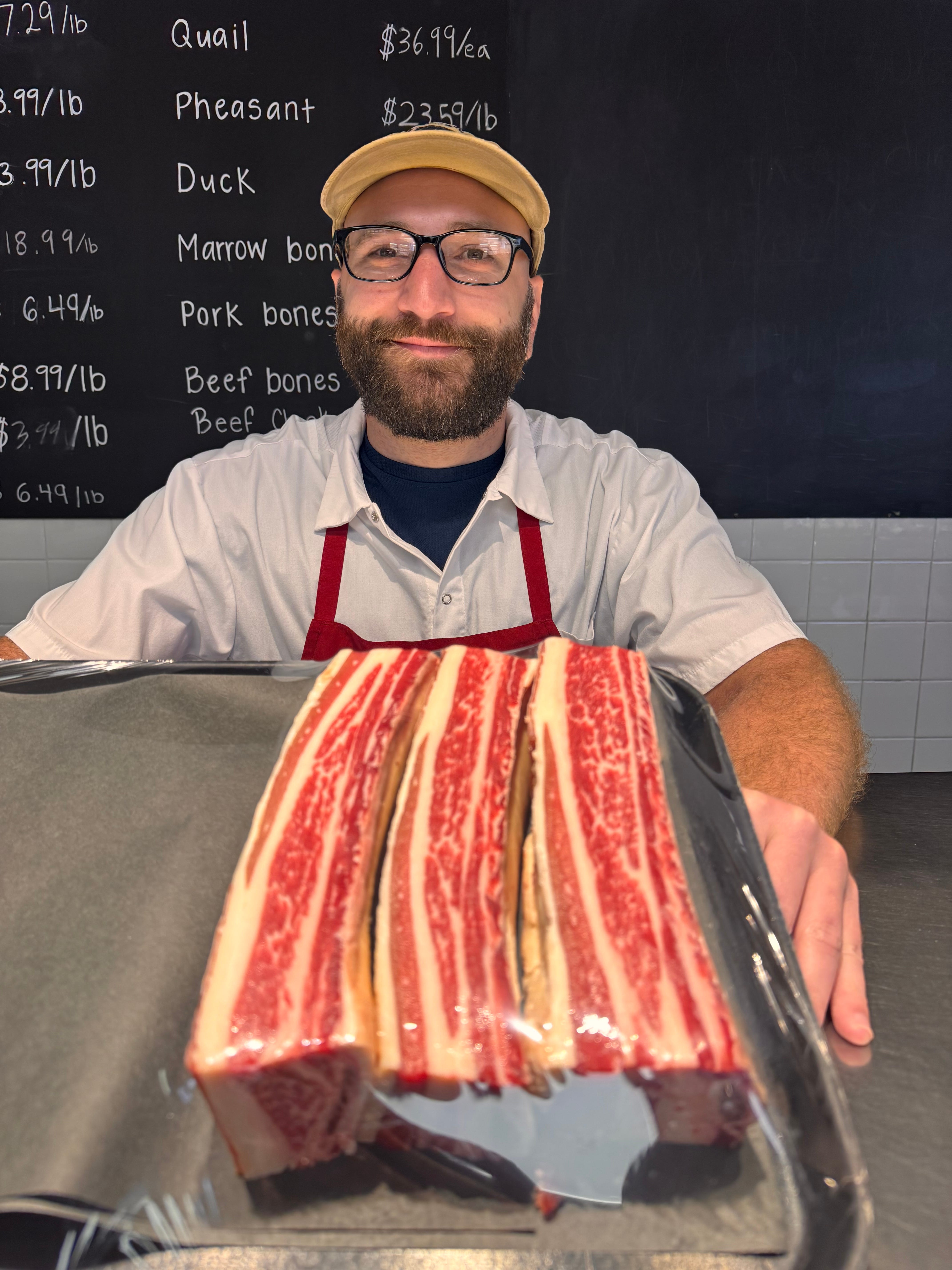
On the cut. Ask your butcher for English-cut short ribs from the chuck end, cut into individual bones about 2 inches thick. Not flanken — flanken is cross-cut and thin, wonderful on a grill, wrong here. If all you can get is boneless, buy 3 pounds instead of 4 and start checking the temperature at the 3-hour mark.
On the fat cap. Leave it. Four hours at 250°F renders most of it, and what’s left crisps under the sear. Trimming it before roasting gets you dry meat and no crust.
On timing. A three-hour roast at 250°F is not a four-hour commitment. Put them in after lunch, go do something else, and come back with a thermometer. This is a recipe you can run in the background of a Saturday.
Make-ahead. The ribs can be roasted a day ahead, cooled, and refrigerated whole — then brought to room temperature for an hour and seared just before serving. Honestly, this is the better way to do it if you’re feeding people. The pesto is best within a few hours, but it will hold overnight in the fridge with a slick of oil on top; the mint dulls first, so hold back a small handful and stir it in at the last minute if you’re making it early.
What goes with it. Nothing complicated, and nothing else rich. Corn cut off the cob and charred in a dry pan. Tomatoes with too much salt and no dressing. White beans with lemon. A loaf of bread torn, not sliced, for the pesto that ends up on the plate.
Leftovers. Shredded into a bowl of the beans, or on toast with the last of the pesto scraped out of the jar, standing at the counter, which is where most of the good eating in this house actually happens.
That’s the summer. The tomatoes have maybe two weeks left, the basil less than that, and after this we turn toward apples and braises and the long slow half of the year. Cook this one while the garden still has an opinion.
See you in the fall.