

A Christmas Wish List for the Good Life
How a Republican and a Democrat, Two Black Angus Families, and One Unforgettable Year Turned an Ordinary Gift Guide into a Story of What Really Belongs on the American Table

This Christmas wish list for The American Table is not really about things. It is about a way of living: the people at the table, the food on the plate, the stories that get told and retold, and the values that quietly run underneath all of it like a root system. HTSI, the Financial Times magazine, fills its pages with diamonds and watches, selling a fantasy of time and legacy and control. This year, after the deaths of two friends—Kent Knutson and Bobbie Grove—that fantasy feels thinner and the question beneath it feels sharper: if the time is not actually ours to hold, what does it mean to use it well?
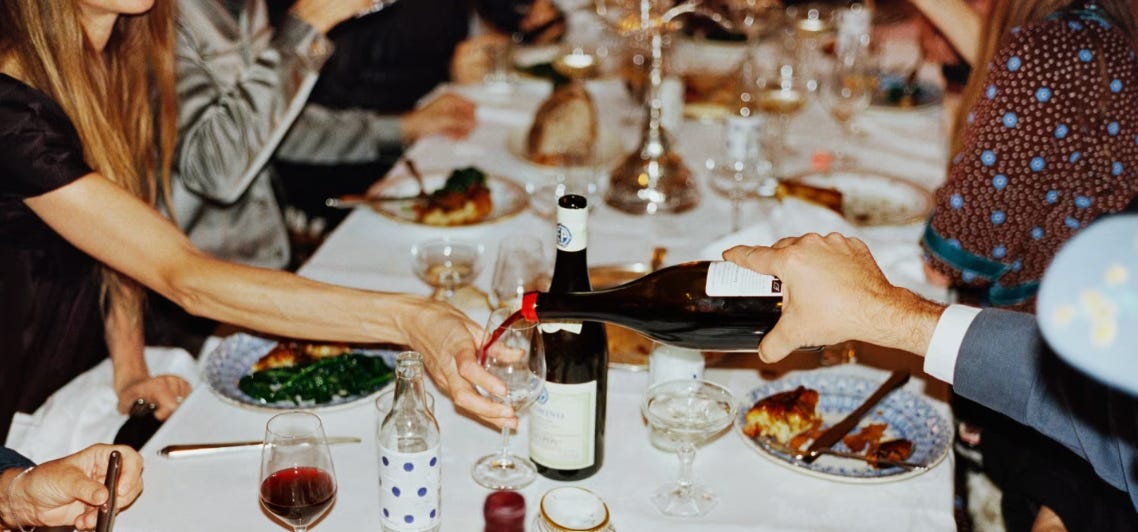
For readers of The American Table, the answers almost always start in the same place: at the table. Picture a winter night when the city outside has blurred into a soft glow, and the rooms inside are a little too warm from the oven and the bodies and the candles burning down too quickly. The table is long, or at least it feels that way. The linens are not perfect, but they are real. The plates do not match, because life rarely does. The glasses might be a mix of inherited crystal and thrift‑store rescues, each one with a history you only half know. On that table sit one or two bottles that at some earlier point were deemed “too good” for an ordinary night. They were meant for a future special occasion. But this year has insisted, with a kind of brutal clarity, that “later” is an illusion. So the corks come up now, for this group in this room on this night, because this is the occasion.
At that table, in that light, Kent and Bobbie belong. Their chairs may be empty this year, but their stories are not. Kent, a Republican and a super‑lobbyist by Washington standards, somehow managed to be one of the city’s rarest breeds: a brilliant dreamer of a human being with a gentleness and kindness that cut through the usual noise. He stood on the opposite side of the aisle from a Democrat like me and yet occupied the same inner circle of friendship. That is not an accident. Kent had an anchor that predated and outlasted the Hill: his family’s black Angus heritage in South Dakota. The cattle, the land, the family history—they gave him a kind of balance and perspective that no committee hearing could touch. Karen and the kids, whom I adore, were part of that anchor too, tethering him to something solid whenever Washington tried to spin him off his axis.
Bobbie Grove, the black Angus genius of Somerville, carried a parallel story in a different key. The Grove family’s black Angus in Somerville were not just animals on pasture; they were the living expression of a way of life. Bobbie knew his cattle the way a watchmaker knows his movements, with an intimacy earned over years and seasons and setbacks. Like Kent, he staked his identity on something older and steadier than any headline. His pride, his wisdom, his sense of self were wrapped up in that herd and that land and that family name. Two men from different geographies and different daily worlds—one in the high‑pressure circuitry of K Street, one in the pastures of Somerville—both found their center in the same rural DNA.
That is the strange geometry of an American life. You can have a Washington lobbyist and a Somerville cattleman, and their lines still meet at the same table through a mutual love of black Angus cows, farming families, and one shared friend who straddles both worlds. Somewhere between South Dakota and Somerville, between the Grove pastures and the Knutson memories, a quiet braid was tied—through conversations, shared meals, and the understanding that who raises your food, and how, is not a minor detail but a moral one. A Christmas wish list that ignores their absence would feel thin. So this one does the opposite: it lets them in and lets them lead.
In practical terms, that means some of the “wishes” on this list are scenes rather than items. There is the wish for more nights when the good bottle gets opened not for prestige but for love. A grower Champagne someone drove across town to find, or a serious red with years on it, is uncorked after a simple grace and a mention of the people who taught us what good cattle, good land, and good friendship look like. The cork eases out, the room goes briefly quiet, glasses are raised, and for one moment everyone present understands that this is not a rehearsal. No tasting notes are necessary. The only important fact is that the wine is finally being used for what it was meant for: to mark a real moment with real people.
Another wish lives in the room where the books collect. On a side table or a chair by the window there is a stack: a new novel, a sharp book of essays, a serious history, a volume on food or farming, a bracing read on democracy or citizenship. They lean into one another like a group photo from different decades. For American Table readers, this stack is its own kind of luxury. It represents time claimed back from the endless scroll, attention directed toward something more demanding than a headline. In a year marked by loss, reading becomes an act of respect—for your own mind, and for the minds that have tried to leave us something sturdy and wise. A wish list that includes books is not making a token nod to “self‑improvement”; it is arguing that a life well lived asks you to go beyond your priors, to learn the stories of places like South Dakota and Somerville, to understand the systems and histories that brought food to your plate and neighbors to your street.
HTSI sells the romance of watches: tiny movements, perfect complications, polished cases that promise mastery over time. The American Table version of that romance is a plane ticket or a train ticket, a purposeful journey in which time is not conquered but savored. A trip to New Orleans in February, to Charleston before the heat, to a small Midwestern city quietly emerging as a food town, or to a hill town in Italy if you can stretch that far. The true “complication” is how vividly you can remember the first morning walk: the café you stumble into for coffee, the bakery where the door sticks, the exact way the light hits a side street you will almost certainly never see again. A dinner in a small, unassuming restaurant in a city where you barely know your way around can take on the weight of an heirloom when one of the people at that table is no longer alive to tell the story. So one wish on this list is simple: that you mark the coming year not by acquisitions but by meals and trips and conversations that etch themselves into your memory.
And then there is the kitchen, the American atelier. HTSI devotes spreads to workshops where a single ring or watch is brought into being by hand. The corresponding fantasy here is humbler and more accessible: a Sunday afternoon with no agenda but to cook. A heavy pot, a slow simmer, a wooden spoon stained by decades of sauces, a cutting board carved with knife marks like notches on a timeline. The wish is partly for the right tools: a knife that feels like an extension of your hand, a Dutch oven that can go from braise to bread to soup without protest, bowls and pans that have followed you from one life to the next. But more than that, it is for the courage to use them as often as you can, with the people you love, instead of waiting for some perfect, uncluttered ideal of domesticity. The meals you remember after someone dies are almost never the elaborate ones. They are the slightly chaotic Tuesday dinners, the over‑salted roasts, the breakfasts where the coffee was too strong and the conversation unexpectedly tender.
Because this is The American Table, the story does not stop at the edge of the countertop. Our tables are private spaces with public consequences. Just as HTSI eventually pivots from things to “foundations” and legacies, this wish list has to move outward into the civic square. One wish is for a country in which people like Kent and people like me—Republican and Democrat, lobbyist and critic—still sit down together in good faith, anchored in something older and sturdier than any party line. Another is for readers to support the ecosystems that make a real American table possible: local newspapers and nonprofit newsrooms that tell uncomfortable truths; food banks and community kitchens that keep neighbors from slipping through the cracks; legal clinics, arts organizations, and small farms hanging on at the edge of viability.
And then there is the specific inheritance of black Angus. To honor Kent and Bobbie is to recognize that the steak on your plate did not appear by magic. It came from land someone stewarded, from animals someone bred and tended, from a family that staked its identity on producing something excellent and honest. So the wish list includes a quiet directive: know your farmer. Learn who in your region is raising cattle, vegetables, grain, fruit with care and intelligence. Buy from them when you can. Tell their stories when you sit down to eat. Support the next generation who might otherwise decide that this work is too hard and too lonely to continue.
All of this adds up to a Christmas list that looks very little like a standard catalog and very much like a map. It points toward full tables, yes, and good bottles, and far‑flung meals when fortune allows. But it also points toward a life lived generously and awake. A life where a Republican and a Democrat can argue and still leave the table closer than when they sat down. A life where black Angus heritage in South Dakota and Somerville is not a quaint detail but a source of balance, wisdom, and pride. A life where we do not hoard the good wine, the blank pages in the passport, the sturdy books on the shelf, or the better angels of our nature for some future year when things are calmer.
So when you sit down to make your own list this season, imagine it less as a ledger of acquisitions and more as a set of promises. To open the bottle. To book the trip. To buy the book and actually read it. To cook the meal even if the kitchen is a mess. To support the journalist, the farmer, the neighbor doing unglamorous work. To raise a glass to Kent and Karen and the kids, to Bobbie and the Groves, to South Dakota and Somerville and every place in between that sends its labor and love to your plate. The American Table Christmas wish list, at its heart, is about this: using what we have—time, attention, resources, affection—fully and bravely now, because the people who taught us how to live that way have just reminded us, in the hardest way, that “someday” is not a plan